
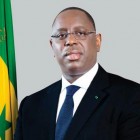
Biography
Biography
President Macky Sall was born on December 11, 1961 in Fatick, the town to which he served as Mayor from 2009 to 2012. President Sall was Prime Minister for three years from 2004 to 2007, and also acted as President of the Senegalese National Assembly from 2007 to 2008. Elected fourth President of the Republic of Senegal in March of 2012, he took office on April 2, 2012. Married to Marième Faye, President Macky Sall has two sons and one daughter.
Youth and Education
Born into a family of four siblings, President Macky Sall was raised in Fatick (central western region of the country) and in the Fouta region (in the north of Senegal). During his studies at the Faculty of Dakar, he joined the Marxist-Leninist Movement, And-Jëf. He would soon leave the movement, sharing neither its political ideas nor the boycott strategy it adopted toward the 1983 presidential election against the Left wing. Instead, Mr. Sall cast his vote for the Liberal Party, doing so again in the1988 presidential elections. He continued his studies and became a geological engineer and geophysicist, training at the Institute of Earth Sciences of Dakar (IST) and the National School for Petroleum and Engines (ENSPM) of the French Petroleum Institute of Paris (IFP). He is a member of several national and international associations of geologists and geophysicists.
Early Political Life
Once graduated, he became part of the Senegalese Democratic Party (PDS) in the late 1980s. From December 2000 to July 2001, he worked as the Chief Executive Officer of the Senegalese National Oil Company (PETROSEN) – where he served as Head of the Database Division for multiple years – as well as Special Advisor to the President in charge of Energy and Mines. From May 2001 to November 2002, he held the position of Minister of Mines, Energy and Hydraulics. From November 2002 to August 2003, he served as Minister of State and Minister of Mines, Energy and Hydraulics in the government led by Mame Madior Boye. From August 2003 to April 2004, he was Minister of State, Minister of the Interior and Local Collectivities, and spokesperson of Idrissa Seck’s government. Concurrently, he was appointed.
Head of Government
Macky Sall was appointed Prime Minister on April 21, 2004. He held that position until June 19, 2007, thus becoming the longest-servingPrime Minister at that time under the President. Initially little-known, he made his mark from his first keynote speech addressing the leaders of the opposition to introduce his general policy. Mr. Sall then proceeded to work on the implementation of State projects that had been shelved: highways, Dakar’s “Corniche” (coastal line of the Capital), the new airport, etc. Additionally, as Chief of Cabinet he ran the campaign for the President’s reelection in 2007.
President of the National Assembly
On June 20, 2007, President Macky Sall was elected President of the National Assembly with 143 votes cast out of the 146 voting members. However, by attempting to summon Karim Wade, son of the President of Senegal, to the National Assembly to testify in the hearings on the work of the ANOCI (National Agency for the Organization of the Islamic Conference), he opened an unbridgeable divide. The position of Vice President of the PDS was abolished and the term of office of the National Assembly President was reduced from five years to one. He left office in 2008 .
President of the “Alliance for the Republic” Party (APR-Yaakaar)
On November 9, 2008, during an official statement delivered in Wolof and French, Mr. Sall announced his departure from the Senegalese Democratic Party (PDS) as well as his removal from all offices he held thanks to the presidential party.
On December 1, 2008, he founded, with about thirty ex-officials of the PDS, the political party “Alliance for the Republic” (APR-Yaakaar), which won the local elections on March 22, 2009 in every municipality of the Fatick region, his stronghold. Through the coalition formed with the other parties belonging to the “Bennoo Siggil Sénégal,” the victory extended to the town of Gossas, twelve local communities in the North of the country, and three in the South, as well as all major cities of Senegal.
With his eyes on the Senegalese presidential election of 2012, Mr. Sall embarked on a tour of Senegal’s heartland as well as various major cities of the world to meet members of the Senegalese diaspora.
In 2010, according to an opinion poll, he was in the lead to win the presidential race in Dakar and in his own region. Being a polyglot – he has knowledge of Wolof, Serer, Pulaar, French and English – Mr. Sall also embodied a new generation in Senegal’s political history.
President of the Republic
As a candidate of the “Macky 2012” coalition, he campaigned throughout the country under the slogan “the path to true development,” while keeping the lines open with the Opposition Movement of June 23 (M23). Mr. Sall took second place in the first round, with 26.58% of the votes, compared to34.81% for the incumbent President. Before the second round, he rallied all defeated candidates in the Benno Bokk Yakkar coalition (meaning “united for the same hope” in the local language, Wolof) and won the election on March 25 over the incumbent -. The outgoing President called Mr. Sall on the same evening to congratulate him before the results were officially proclaimed by the Constitutional Council (65.80% of the votes, compared to34.20% for the incumbent).
Elected fourth President of the Republic of Senegal, Macky Sall was sworn into office on April 2, 2012 at the King Fahd Palace-Soleil Hotel.
True to his promise to reduce government expenses, he removed certain ministerial privileges and abolished 59 commissions and directorates deemed unnecessary including: The National Agency of Senegal's New Harbors; The Directorate of Small Aircraft Construction; The National Agency of the Desert High Authority; The Senegalese Office for Industrial Property and Technology Innovation, which overlapped with the Senegalese Agency for Industrial Property and Technology Innovation. Mr. Sall also announced audits on his predecessor’s management.
Furthermore, Mr. Sall revived the Court for the Repression of Illicit Enrichment and announced the creation of a National Anti-Corruption Office and of a National Commission for Property Restitution and Recovery of Ill-Acquired Gains.
To help reduce the cost of living, the government announced a price reduction on oil, rice, and sugar. Retirement pensions were raised and peasants received emergency subsidies. To save the school year, several national conferences on education were planned. In the field of foreign policy, he focused on rebuilding traditional allia